Crowd control — commonly shortened to CC — is one of those terms every League of Legends player picks up almost immediately, but the actual mechanics behind it stay fuzzy for a surprisingly long time. Players know a stun is bad to walk into and a slow is annoying to fight through, but the finer distinctions between CC types, how they interact with each other, and how items like tenacity actually reduce them rarely get explained clearly anywhere in the client itself.
Hard CC vs. Soft CC: The Core Distinction
The broadest useful way to split crowd control is into hard CC and soft CC. Hard CC removes a player's ability to act entirely — stuns, roots, suppressions, knockups, taunts, fears, charms, and sleeps all fall into this category, since each one takes meaningful control away from the affected champion for its duration. Soft CC, by contrast, hinders a champion without fully locking them out of acting — slows are the clearest example, reducing movement speed without preventing abilities or attacks entirely.
This distinction matters practically because hard CC is generally treated as far more dangerous in team fight planning, since a well-timed hard CC effect can single-handedly remove a priority target from a fight for its full duration, while soft CC only reduces that target's effectiveness rather than eliminating it. Understanding which category a given ability falls into is often more useful than memorizing every individual CC type by name.
The Full List of Hard CC Types
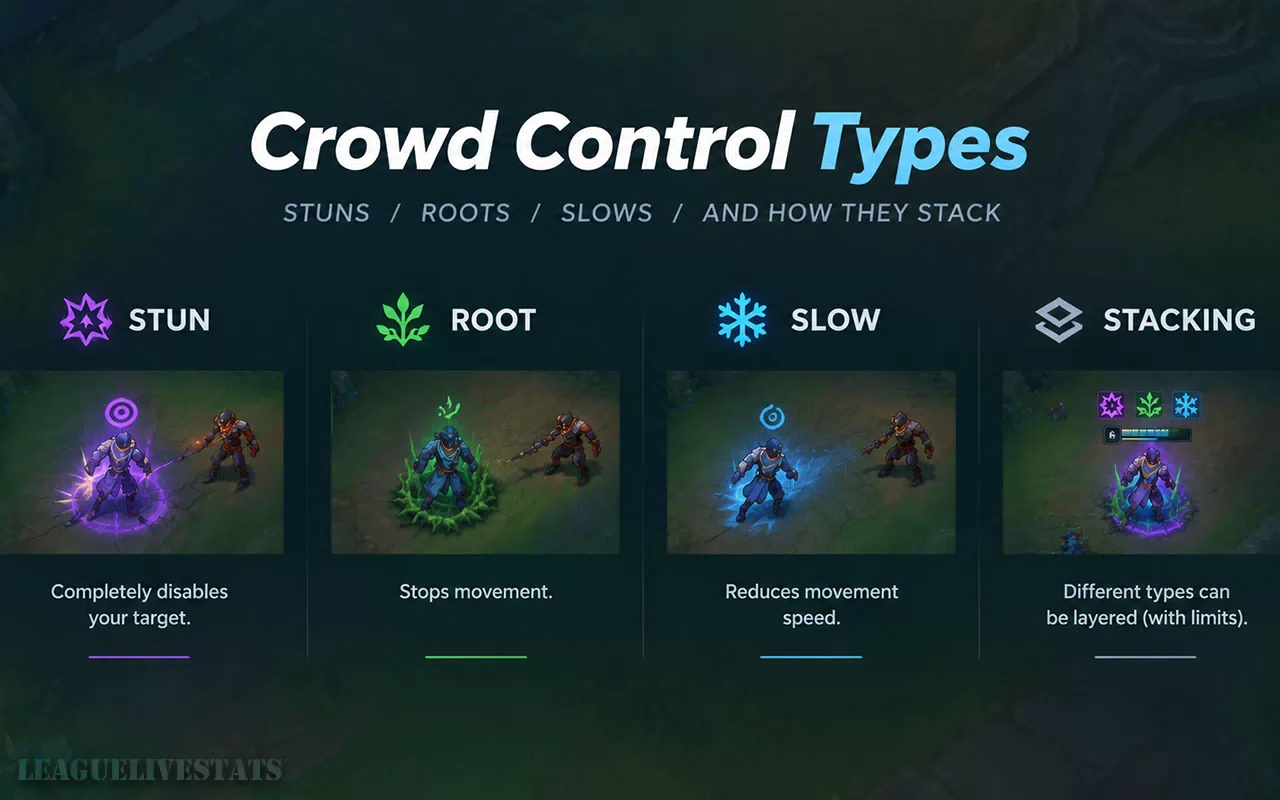
Stuns are the most familiar hard CC type, freezing a champion in place and preventing any action until it ends. Roots (sometimes called snares) prevent movement specifically but still allow abilities and attacks to be used from a fixed position, which makes them meaningfully different from a full stun in practice, especially for champions with long-range abilities who can still function while rooted.
Knockups briefly launch a champion into the air, during which they can't act, and are notable for a specific mechanical detail: many champions' own follow-up abilities specifically require an airborne target to combo off of, which is why knockups tend to be treated as high-value setup tools in champion kits built around team coordination. Suppressions are a particularly severe form of hard CC that locks a target in place, often alongside continuous damage, and critically cannot be removed by most cleanse effects, making them one of the more feared CC types in the game.
Taunts force a champion to auto-attack the taunting source and prevent other actions, fears force a champion to run in a random, uncontrollable direction, and charms force a champion to walk toward the source of the charm. Sleep effects incapacitate a target until they take damage, at which point the effect ends early, giving sleep a unique risk-reward dynamic compared to other hard CC types with a fixed duration.
Soft CC and Why It's Still Worth Respecting
Slows are the dominant soft CC type in League of Legends, reducing movement speed by a percentage for a set duration and frequently stacking with other slows already on the same target, though usually only the strongest active slow actually applies rather than a full additive stack. Grievous Wounds, while not a traditional CC type, functions similarly in practice by reducing incoming healing, effectively countering a target's sustain rather than their mobility or actions.
Soft CC's real value shows up less in isolated moments and more in the aggregate — a slow that helps land a follow-up ability, or that prevents an enemy from disengaging a losing fight, often ends up mattering just as much as a hard CC effect would have, even though it never technically removed the target's ability to act.
Tenacity: The Stat That Reduces CC Duration
Tenacity is a stat that reduces the duration of most hard CC effects (and, on certain sources, slow duration specifically) by a percentage, and it's available through certain items, runes, and a handful of champion kits directly. A champion with 30% tenacity, for example, experiences a one-second stun as roughly 0.7 seconds instead — a meaningful reduction in a fight where every fraction of a second matters.
It's worth knowing that tenacity generally doesn't reduce suppression duration, which is part of why suppressions are considered so dangerous even for champions who've built significant tenacity elsewhere in their kit or itemization. Building tenacity is particularly valuable against team compositions with heavy, prolonged hard CC, since its value scales directly with how much CC the enemy team is actually applying — against a team with very little CC, the same tenacity investment offers comparatively little benefit.
How CC Stacking Actually Works in a Fight
A common misconception among newer players is that stacking multiple CC effects on the same target extends the total lockdown duration in a simple additive way. In practice, most hard CC effects overwrite rather than stack when applied to the same target in quick succession, meaning a second stun applied while the first is still active typically doesn't add meaningfully more locked-out time than the longer of the two durations alone. What actually matters more in team fights is CC chaining — landing one crowd control effect right as a previous one is about to expire, so the target never gets a window to act, rather than assuming multiple simultaneous effects compound into something dramatically longer.
This is a big part of why coordinated team fight execution matters so much at higher levels of play: a team that lands crowd control in a staggered sequence, covering a target continuously, gets far more value than a team that lands several CC effects at the exact same moment and then has no follow-up once they all expire together.
Cleanse and Other CC-Removal Tools
Beyond tenacity, several tools exist specifically to remove crowd control outright rather than just reduce its duration. The Cleanse summoner spell removes most active hard CC effects (though not suppressions) and grants brief additional tenacity afterward, making it a strong pick specifically against compositions built around a single, game-defining CC effect — a heavy engage support, for instance, or a team leaning entirely on one powerful crowd control ultimate. Certain champion kits also include built-in cleanse-like effects as part of their base abilities, which is worth knowing when evaluating how vulnerable a given champion actually is to being locked down in a fight.
Since Cleanse and similar effects are reactive rather than preventative, timing matters enormously — using it the instant CC lands, rather than hesitating, is usually correct, since most hard CC effects deal little value beyond the lockout itself, and removing that lockout immediately preserves the most possible time to actually act afterward.
The Bottom Line
Crowd control is a much richer system than the single, vague label suggests, and understanding the real distinctions between hard and soft CC, how tenacity actually interacts with each type, and how CC chaining works in practice changes how both individual trades and full team fights should be read. Recognize that hard CC effects generally overwrite rather than stack additively, that tenacity doesn't help much against suppressions specifically, and that reactive tools like Cleanse are most valuable used immediately rather than saved indefinitely. None of this requires memorizing every ability in the game — just understanding the underlying categories is usually enough to make noticeably better decisions in a fight.
For a complete glossary of crowd control terms and current tenacity values by item and rune, Riot Games' official glossary and the League of Legends Wiki's crowd control page are both useful references to check.