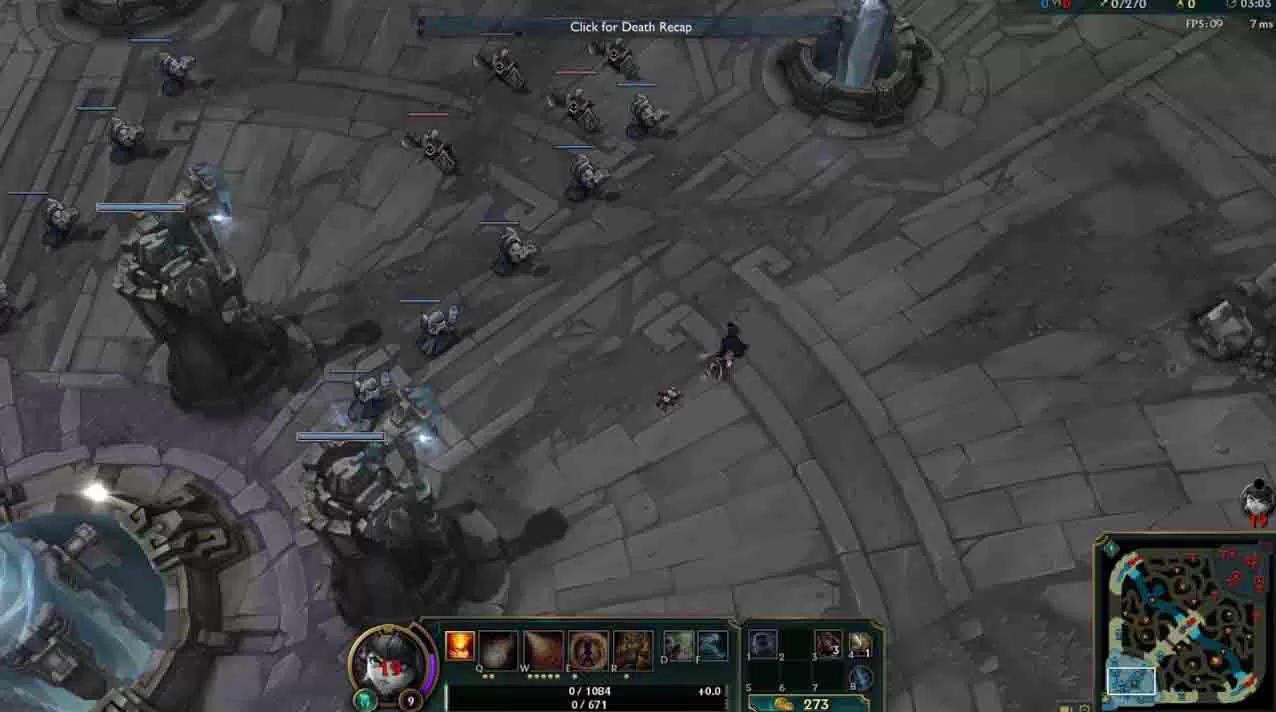
Most players treat deaths as a simple tally — one more on the scoreboard, one more point for the enemy team, one more reason a teammate might start typing in chat. But a death isn't a fixed cost. The same death can be almost free in one situation and game-losing in another, and learning to tell those situations apart is one of the quieter skills that separates players who climb steadily from players who feel like they're always one bad fight away from falling behind.
What a Death Actually Costs
A death costs three things at once: time spent away from the map, gold the enemy collects for the kill, and the pressure your absence creates for the rest of your team. The time portion is the most overlooked part. Death timers grow longer as the game goes on, which means a death at level six is a short interruption, while a death at level sixteen can take a big chunk of a minute out of the fight, long enough for the enemy to take an objective, push a lane, or simply end the game before the player is even able to respawn.
The gold the enemy earns is the more visible cost, but it often matters less than the lost map presence. A player who dies right before a dragon spawns or right before a Baron attempt isn't just giving away a kill, they're giving the enemy a free window to take an objective while the team is a player short, and that cost tends to far outweigh the gold alone.
Not All Deaths Are Equal
The most useful mental shift in risk management is separating deaths by what they cost the team rather than treating them all the same. A death while trading fairly for a kill, or while forcing the enemy to burn important tools, can be a perfectly reasonable trade. A death while chasing a low-health enemy deep into their territory with no vision, on the other hand, is usually just a gift.
What matters most is the timing. A death that happens in a quiet moment, with no objective spawning soon and no push available to the enemy, costs very little. A death that happens thirty seconds before a major objective, or while the enemy team has a numbers advantage to exploit immediately, costs the team much more than the individual death suggests, because it hands the enemy a window they otherwise wouldn't have had.
Knowing When to Stop Chasing
One of the most common ways to die for no reason is chasing an enemy who's already been beaten. A fight that went well and ended with an enemy on low health often turns into a disaster when the player on the winning side keeps chasing past the point of safety, running deeper into enemy territory without vision and walking into a group of enemies who were waiting just out of sight.
The simple rule is that a kill isn't worth much if getting it requires dying in return, particularly when the enemy's remaining team is close enough to punish the chase. Backing off and resetting after winning a fight, rather than pushing for an extra kill, usually ends up more valuable than the kill itself would have been.
Calculated Risks Are Part of the Game
None of this means playing completely passively. Winning games requires taking risks at the right moments, like contesting an objective when the odds are close, diving a tower when the enemy has used their defensive tools, or forcing a fight when the team has a clear advantage. The goal of risk management isn't to avoid risk entirely, it's to take risks when the potential reward clearly outweighs the potential cost.
A useful question to ask before committing to any risky play is what happens if it fails. If the answer is that the team loses a minor skirmish and nothing else, the risk is probably worth taking. If the answer is that the team loses a game-defining objective, or falls so far behind that recovering becomes unlikely, the risk deserves a much higher bar before being worth it.
Playing From Behind and Ahead
The right level of risk shifts depending on the game state. A team that's behind often needs to take more calculated risks to create comeback opportunities, since playing safely while falling further behind is rarely a winning plan. A team that's ahead should do the opposite, avoiding unnecessary fights and instead focusing on safe objective control, since every unnecessary risk gives the enemy a chance to claw back into the game.
This is why throwing an advantage is so common at every level. Players who get ahead often keep playing as aggressively as they did when behind, taking fights they don't need and giving the enemy openings they could have simply denied by playing patiently.
The Bottom Line
Death timers and risk management aren't flashy topics, but they decide a huge number of games without anyone noticing. Understanding that deaths cost time and map presence as much as gold, that timing matters more than the death itself, and that the right level of risk depends on whether the team is ahead or behind will do more for a player's consistency than almost any mechanical improvement.
For current death timer values and scaling, the League of Legends Wiki's death page is a useful reference to check.