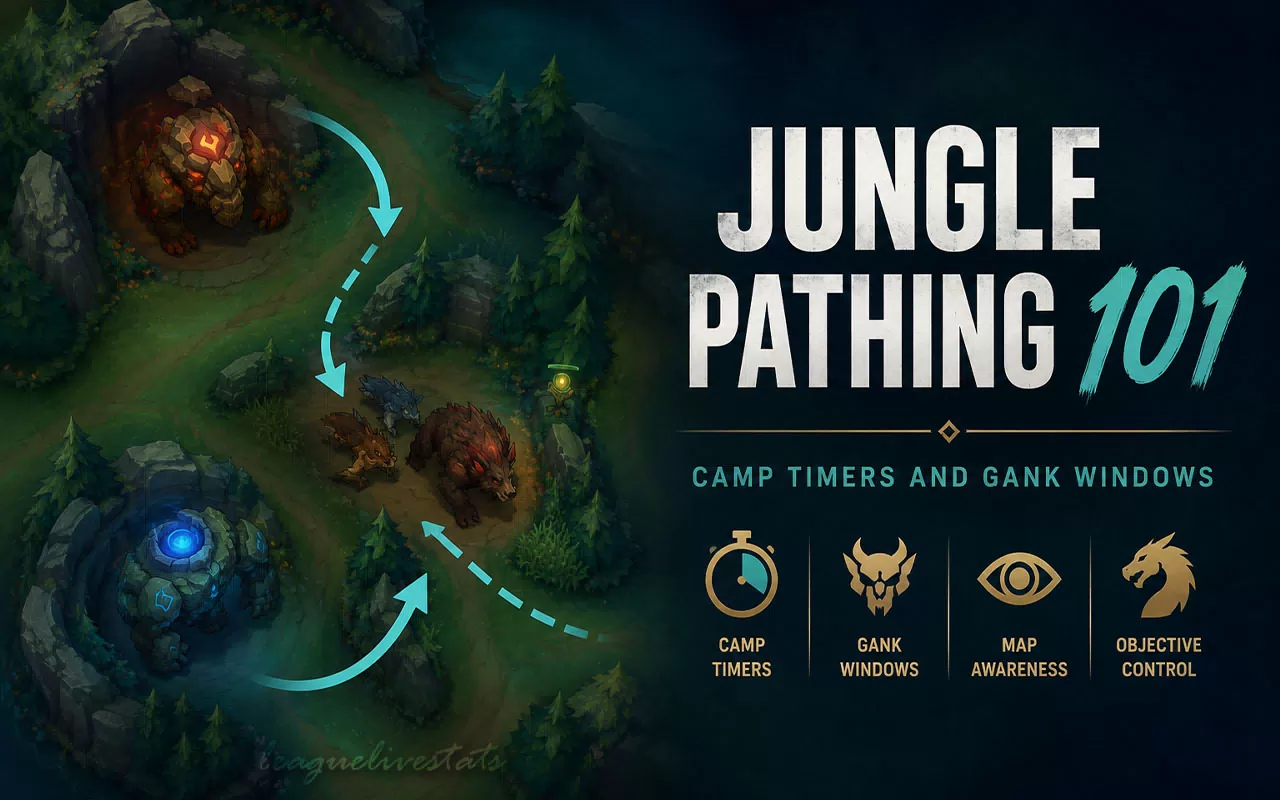
Jungle is widely considered the hardest role to learn in League of Legends, and the reason isn't mechanical — it's informational. A top laner only has to think about their own matchup. A jungler has to track four lanes, their own camp timers, the enemy jungler's likely position, and objective spawn times, often all at once, from the very first minute of the game. Most new junglers don't lose because they play their champion badly; they lose because they're pathing without a plan and reacting to the map instead of controlling it.
Why Your First Clear Order Matters More Than People Think
The order you clear your jungle camps in isn't arbitrary — it's built around your champion's damage profile, your own health total, and which lanes are worth ganking early. A jungler who takes heavy early damage typically wants to start on the tougher camp (like Red Buff or the Krugs) while at full health and finish on something safer, so they're not walking into a gank attempt with half a health bar.
Just as important is starting on the side of the map where your strongest early-game lane is. If your bot lane has strong crowd control and kill pressure at level 2 or 3, starting your clear on the bot side of the jungle and pathing toward them first lets you convert that early gank window before the enemy jungler can contest it. Starting on the wrong side purely out of habit is one of the most common — and most fixable — mistakes new junglers make.
Camp Timers Are the Actual Skeleton of Jungle Strategy
Every jungle camp respawns on a fixed timer once it's been cleared, and elite junglers essentially play the entire game around these numbers. The buff camps (Red and Blue) come back roughly five minutes after being taken, while smaller camps respawn faster. Knowing these numbers by heart — rather than checking them mid-game — is what lets strong junglers show up exactly when a camp is about to spawn instead of wasting time waiting on it or, worse, giving it up to the enemy jungler by arriving late.
A habit worth building early: every time you take a camp, glance at the clock and do the mental math for when it respawns. After a few dozen games, this becomes automatic, and it's the single biggest difference between a jungler who's always "on time" for their buffs and one who's constantly a step behind.
Reading Gank Windows Instead of Just Walking Into Lanes
A gank that arrives at the wrong moment isn't just wasted time — it can hand the enemy laner a free kill instead. The strongest gank windows tend to share a few traits: the enemy laner has just used their escape ability on a minion wave or to poke, the lane is pushed toward your side of the map (giving you a shorter, safer walk in), or your ally in that lane has recently landed crowd control that softened the enemy up.
Conversely, ganking a lane where the wave is pushed toward the enemy turret is usually a losing proposition — you're walking into a longer, more exposed path, directly into turret range, against an enemy who has a much shorter distance to retreat. Recognizing wave state before committing to a gank is a skill that translates almost one-to-one into win rate, since it cuts down dramatically on ganks that accomplish nothing but revealing your position.
Tracking the Enemy Jungler Without Vision on Them
You won't have eyes on the enemy jungler most of the game, but their position is rarely a total mystery if you pay attention to indirect signals. A lane suddenly getting aggressive when it was previously passive often means their jungler just arrived to support them. A lane going quiet and passive can mean the opposite — their jungler has left to gank somewhere else, and that lane is temporarily unsupported.
The minimap ping for missing enemy laners exists for exactly this reason, and experienced junglers treat every "MIA" call as a data point about where the enemy jungler might be heading, not just information about that one lane. Counter-jungling — invading the enemy's own camps when you can reasonably guess they're elsewhere — is a high-risk, high-reward extension of this same tracking habit, and it's usually not worth attempting until you're confident reading these signals.
Objectives Should Shape Your Entire Pathing Plan
Dragons and the Rift Herald spawn on fixed timers early in the game, and a jungler who ignores this while endlessly farming camps is giving up a huge amount of potential value. The strongest junglers plan their clear path backward from the next objective spawn, making sure they (and ideally their team) arrive with vision and priority before the enemy does, rather than realizing the dragon is up while they're on the opposite side of the map.
This also means camp efficiency sometimes has to take a back seat to positioning. Skipping a camp or two to be in the right spot for a contested objective is frequently the correct trade, even though it feels counterintuitive to "waste" gold sitting on the ground.
Full Clears vs. Three-Camp Ganking: Choosing a Style That Fits Your Champion
Not every jungler should play the role the same way, and one of the biggest jumps new junglers make is realizing that pathing isn't one-size-fits-all. Champions built around scaling and strong late-game teamfighting — think Master Yi or Kayle-style junglers — often benefit from a full clear: taking every available camp before making a play, prioritizing experience and gold over early kill pressure, and trusting that their power spikes later in the game.
Champions with strong early crowd control or burst, on the other hand — Lee Sin, Elise, or similar — are usually better off pathing toward just two or three camps before looking for their first gank, converting early game strength into kills and lane leads while the enemy jungler is still doing a slower clear. Neither approach is universally correct; the mistake is picking a pathing style that doesn't match what your specific champion is actually good at. A full-clear champion that rushes into a gank at level 2 with no real burst usually just reveals their position for nothing, while a burst-heavy early-game champion that insists on a full clear is giving up their entire reason for being picked.
Talking to Your Team Changes What "Correct" Pathing Even Looks Like
Jungle is often treated as a solo puzzle, but the best junglers treat their laners as information sources and collaborators, not bystanders. A laner who pings that they're low on mana, or that the enemy has just used a key ability, is handing the jungler a much clearer gank window than anything visible on the map alone. Likewise, a jungler who pings their intended path a few seconds in advance gives their laner a chance to play more aggressively in anticipation, instead of missing the window entirely because they didn't know help was coming.
This kind of back-and-forth communication is one of the more overlooked reasons why some junglers seem to "have game sense" while others with similar mechanical skill don't — a large part of that sense is actually built from paying attention to what teammates are telling you, directly or through pings, rather than reading the map in isolation.
The Bottom Line
Jungle rewards planning far more than it rewards raw mechanical skill, which is exactly why it feels so overwhelming at first and so mechanical once the habits click. Learn a clear order suited to your champion, memorize your camp timers instead of checking them mid-game, gank lanes with favorable wave states instead of just the closest one, read indirect signals to guess where the enemy jungler is, choose a full-clear or early-gank style that actually fits your champion, lean on your teammates' pings as real information, and plan your whole route around upcoming objectives rather than treating them as an afterthought. None of this requires exceptional mechanics — it requires treating the map as a puzzle with a rhythm, rather than a series of random encounters.
For exact current camp respawn timers and jungle item stats, which Riot adjusts periodically between patches, Riot Games' official patch notes and the League of Legends Wiki's jungle guide are the most reliable places to double-check before a new season starts.