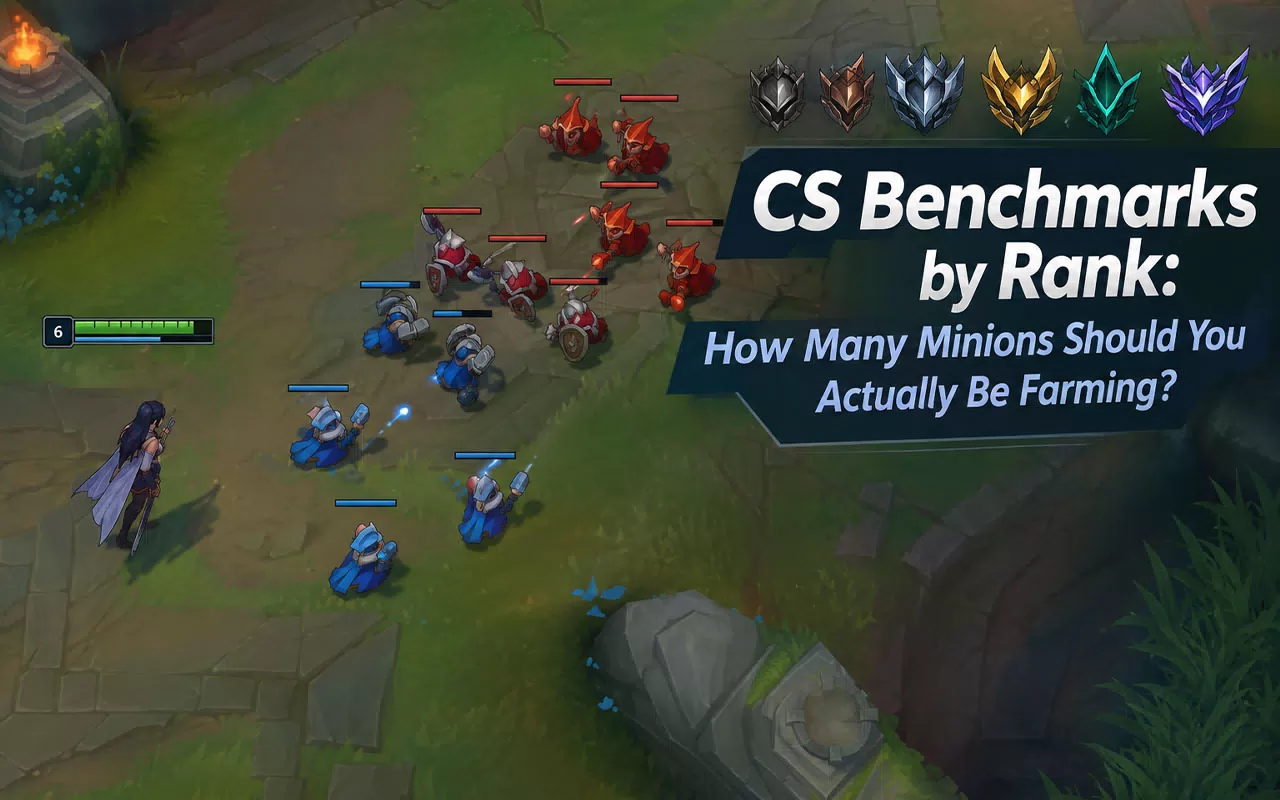
"Just CS more" is some of the most common advice thrown around in League of Legends, and it's also some of the least useful on its own, because it never comes with a number attached. Farming well doesn't mean farming perfectly — it means farming well enough relative to your rank and the pace of your specific game, and most players have no real sense of what that benchmark actually looks like until someone puts a number next to it. This guide breaks down realistic CS targets by rank and game length, along with the habits that actually move that number in a lasting way.
Why CS Per Minute Is a Better Number Than Total CS
Total CS at the end of a match is a misleading number to chase, mostly because games run different lengths. A player who finishes with 180 CS in a 25-minute game is farming dramatically better than one who finishes with 180 CS in a 35-minute game, even though the raw total looks identical on the post-game screen. CS per minute (CS/min) solves this by normalizing for game length, which is why it's the number coaches and high-level players actually track, rather than the total shown by default in the client.
A rough mental shortcut worth keeping: at a reasonable pace, a solo laner should be adding close to one minion every ten seconds during an uncontested wave, which works out to somewhere in the neighborhood of six CS per minute if every single minion were secured. In practice, trades, roams, recalls, and jungle interference mean nobody hits that ceiling consistently, which is exactly why realistic benchmarks sit meaningfully below it.
Realistic CS/Min Benchmarks by Rank
These numbers vary somewhat by role — junglers and supports naturally farm less than solo laners — but for a top, mid, or bot laner, the general benchmarks tend to look roughly like this across the ranked ladder:
Iron through Bronze: Around 4 to 5 CS/min is a reasonable target. Games at this level tend to have frequent, extended fights and less consistent wave management on both sides, which naturally caps how much uninterrupted farming time is available.
Silver through Gold: Somewhere around 5.5 to 6.5 CS/min tends to separate players climbing comfortably from those stuck at the same rank for a long stretch. This is also the range where wave management first starts meaningfully affecting outcomes, since opponents are more likely to punish a badly pushed wave than in lower tiers.
Platinum through Diamond: Roughly 7 to 8 CS/min becomes a more realistic expectation, reflecting cleaner laning phases, fewer wasted minions, and generally less chaotic early games. Players in this range are also more likely to actively deny or freeze a wave against a struggling opponent, which raises the bar for what "good farming" needs to look like just to keep pace.
Master and above: 8.5+ CS/min is common among players who reliably contest every wave and rarely miss a minion without a specific reason — a roam, a recall, or a fight that was clearly worth the trade-off. At this level, farming discipline is close to a baseline expectation rather than a differentiator on its own.
These numbers are meant as a general compass rather than an exact target to hit every single game, since a game with unusually early skirmishing or a lane that gets shoved hard in one direction will naturally push actual CS/min away from any tidy benchmark.
Why Missed CS Costs More Than It Looks Like
A single missed minion feels small in the moment, but the cost compounds more than most players expect. A missed melee minion costs a modest amount of gold, but a missed caster minion — worth noticeably more — adds up quickly across dozens of missed hits over a full laning phase. Riot's own economy design intentionally ties a large share of early gold to minions rather than kills specifically, which is part of why consistent farming has such an outsized effect on which player is actually ahead by the ten-minute mark, even in a lane where neither side has landed a kill.
It's also worth remembering that missed CS isn't just lost gold — it's lost experience as well, since minions grant experience whether or not you land the last hit, but standing in range to farm safely also keeps you in range to soak that experience efficiently. A player who backs off the wave entirely to avoid missing CS, rather than farming from a safer distance, often loses more value from missed experience than they save by not risking a couple of last hits.
A Five-Game Farming Drill
If your CS/min consistently sits below the benchmark for your current rank, a focused block of practice games tends to move the number faster than passively hoping it improves over time.
Game 1 — Baseline check. Play normally, but check your CS/min at the end using the post-game stats screen or a stats site. Don't try to change anything yet — the goal here is just an honest starting number to compare against later.
Game 2 — Prioritize farming over trading. For one game, deliberately deprioritize trades that aren't clearly favorable, and treat every safe last hit as more valuable than a risky poke. This game will probably feel passive, and that's the point — it isolates farming as the single variable being tested.
Game 3 — Practice under pressure. Play a champion or matchup you're comfortable with, but this time focus specifically on maintaining CS even while your lane opponent is trying to zone or pressure you. Losing a little farm to genuine danger is fine; losing it to mild intimidation without a real threat behind it is the habit worth catching.
Game 4 — Track wave state. Add an extra layer: notice whether the wave is pushing toward you or away from you, and adjust your positioning accordingly rather than farming from the same spot regardless of wave state. This is where CS/min habits start blending into broader wave management.
Game 5 — Combine everything. Play a normal game applying all of the above, and compare your final CS/min against Game 1. Even a small, consistent improvement — say, half a CS per minute — reflects a real, repeatable habit rather than a one-off good game.
Farming Isn't Just a Laning Phase Skill
It's worth pushing back on the common assumption that CS/min only matters in the first fifteen minutes. Strong players tend to keep farming discipline well into the mid and late game, picking up minions on the way to objectives or during a recall's walk back to base rather than treating farm as something that stops mattering once laning phase ends. A player who farms excellently for the first ten minutes but then abandons minions entirely once fights start happening around the map often ends up with a CS/min average that looks worse than their actual laning phase performance would suggest — and, more importantly, ends up with less gold than a teammate who kept collecting farm opportunistically throughout the whole game.
The Bottom Line
CS/min is a far more honest measure of farming quality than a raw end-of-game total, and having a real benchmark for your current rank turns vague advice like "just farm better" into something you can actually track and improve. Use the rough tiers above as a compass rather than a strict target, understand why a missed minion costs more than its gold value alone suggests, and consider running a focused block of practice games if your number has been sitting below where it should be for your rank. Farming discipline is rarely the most exciting skill to work on, but it's one of the most reliably rewarded ones on the entire ladder.
For up-to-date gold values per minion type and any economy-related balance changes, Riot Games' official patch notes are worth checking periodically, and stats sites like OP.GG can show your own CS/min trends across recent games for a more personalized benchmark than any general guide can offer.