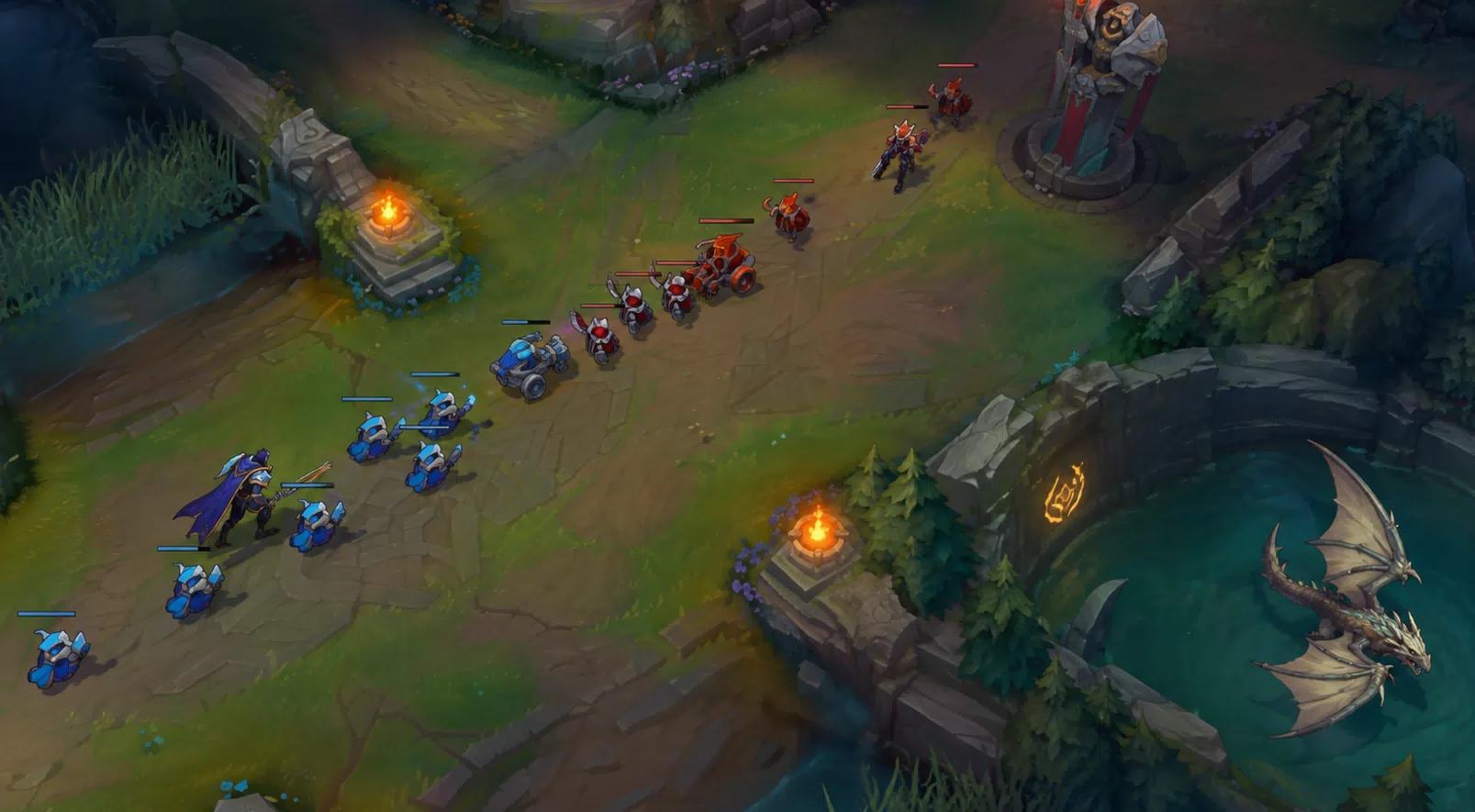
Lane priority is one of those League of Legends concepts that gets mentioned constantly without always being explained clearly. Players hear that mid has priority, bot has no priority, or that the jungler cannot contest an objective because the nearby lanes are pushed in.
What those statements really describe is something fairly simple: who is able to leave their lane first without immediately giving something important up.
That small advantage can decide far more than the lane itself. Priority can determine which jungler gets help during an invade, which team reaches a river fight first, whether an objective can be started safely, and whether a roaming player can move across the map without sacrificing an entire wave.
Understanding priority therefore isn't just about learning how to push. It's about understanding when control of a minion wave temporarily gives your team control over another part of the map.
What Lane Priority Actually Means
Having priority generally means your lane is in a state where you can move before your opponent.
Imagine both mid laners are alive, but one player has just pushed a full wave underneath the enemy turret. The defending player now has a choice. They can stay and collect the minions, or they can immediately follow their opponent into the river and potentially lose the wave.
The player who pushed first has created a window where moving costs less.
That window might only last several seconds, but League fights can be decided within that time. Arriving first can allow a player to establish vision, threaten an enemy jungler, secure an entrance to an objective, or simply make the opposing team abandon a play because they temporarily have fewer players available.
This is why priority shouldn't be confused with winning lane. A player can be behind in kills or gold and still temporarily gain priority by controlling the wave correctly.
Why Junglers Care So Much About Priority
Lane priority becomes especially important when junglers interact with each other.
Suppose your jungler enters the river while the enemy jungler contests the same area. On paper, it may look like a one-versus-one fight. In reality, the state of the nearby lanes can turn it into a three-versus-one surprisingly quickly.
If your mid and bot lanes have their waves pushed toward enemy turrets, they may be able to move immediately. If the opposing laners are stuck collecting those waves, your jungler effectively has temporary numerical support.
The opposite is also true.
A jungler invading while every nearby lane is pushed toward their own team's towers may be entering territory where the enemy laners can rotate first. Even if the invade initially looks safe, the map state is working against it.
This is why good jungle decisions aren't based only on jungle matchups. They also depend on what is happening in the lanes surrounding the play.
Priority Before Dragon and Baron
Objectives make lane priority even more valuable.
Riot's 2026 season changes increased the time teams need to spend fighting epic monsters. Riot specifically explained that these changes make playing for lane priority more powerful because junglers require more protection while taking objectives.
Consider a Dragon fight where your bot lane has pushed a wave underneath the opposing turret before moving toward the river.
The enemy bot lane now has an uncomfortable decision. Following immediately means abandoning farm and experience. Staying for the wave means arriving later to the objective.
Meanwhile, the team with priority can enter the river first, establish vision, and choose its position before the opponents arrive.
That doesn't automatically mean the objective should be started. Priority creates an opportunity; it doesn't guarantee that taking the objective is safe.
Priority Is Not the Same as Permanently Shoving
One of the biggest misunderstandings about priority is assuming that players should constantly push their lanes.
They shouldn't.
Pushing creates advantages, but it can also create vulnerabilities. A champion repeatedly clearing waves and walking toward the enemy side of the lane may become easier to gank. It can also destroy a favorable freeze or put the player in a position where retreating takes much longer.
Priority is most valuable when there is something useful to do with it.
If Dragon is spawning soon, your jungler wants to invade, or your team wants to establish river vision, pushing first can create the time required for those plays.
If nothing is happening on the map, forcing the wave forward purely to have priority may accomplish very little while exposing you to unnecessary risk.
How Priority Creates Roaming Windows
Priority also explains why some roams feel effortless while others cost enormous amounts of gold and experience.
A player who clears the wave before roaming has bought themselves time. The opponent normally needs to respond to the incoming minions before following.
A player who abandons a large enemy wave to roam is doing the opposite. They're starting the play with an immediate cost attached to it.
That doesn't automatically make the roam wrong. A successful fight elsewhere might be worth considerably more than the abandoned minions. The important part is recognizing that the roam has a price.
This distinction helps explain why strong roaming isn't simply about leaving lane frequently. It's about creating moments where leaving lane costs less than what can potentially be gained elsewhere.
When You Should Give Up Priority
Sometimes contesting priority is the mistake.
If the opposing laner is significantly stronger, walking forward simply to match their push can expose you to a bad trade or death. In that situation, safely collecting the wave may be more valuable than trying to maintain control of the river.
The same applies when important enemy champions are missing.
Priority only helps when you can use it safely. Pushing aggressively without information about the enemy jungler or support can turn a small strategic advantage into an unnecessary death.
There are also situations where the wave itself matters more than immediate map movement. Maintaining a freeze, denying farm, preparing a slow push, or simply taking a safe recall can all be better choices than pushing for temporary priority.
The Bottom Line
Lane priority is essentially the ability to act first.
Pushing a wave forces the opposing laner to spend time dealing with it, and that time can be converted into vision, jungle pressure, roams, objective control, or better positioning before a fight.
The important part is understanding that priority isn't valuable by itself. Its value comes from what your team can accomplish during the small window it creates.
Once you start looking at lane waves as timers that determine who can move first, many jungle fights and objective decisions become much easier to understand.
For more information about objectives, lanes, and the basic structure of a match, Riot Games' official League of Legends guide is a useful reference:
https://www.leagueoflegends.com/en-us/how-to-play/
For additional information about the 2026 season changes to objectives and lane priority, see Riot Games' official Patch 26.1 notes:
https://www.leagueoflegends.com/en-us/news/game-updates/patch-26-1-notes/