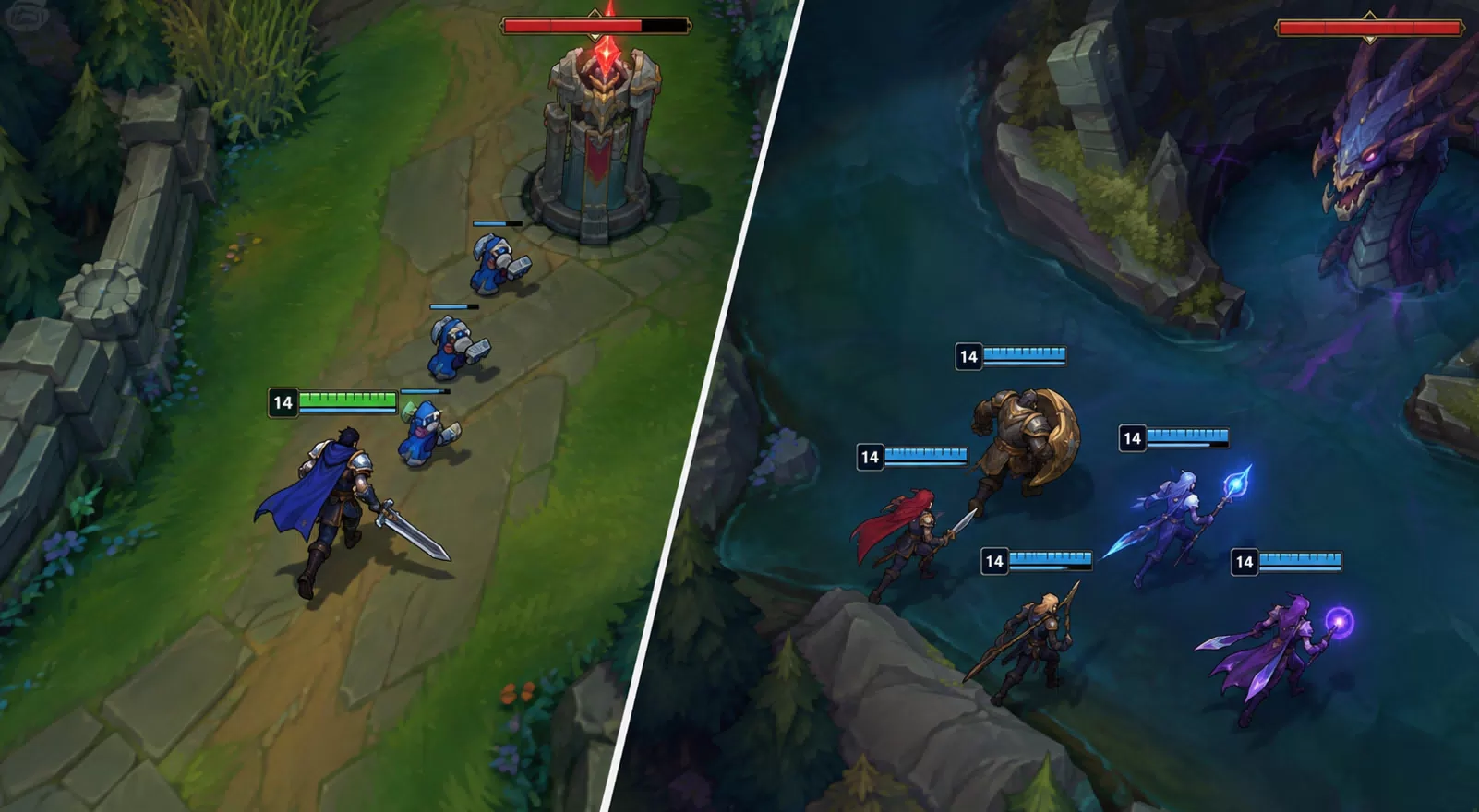
Split pushing looks simple from the outside — one player leaves the group, pushes a side lane alone, and either takes a tower or forces the enemy to respond. In practice, it's one of the more misunderstood strategies in the game, frequently blamed for losses that had nothing to do with the split push itself and just as frequently ignored in situations where it would have been the correct call. The strategy isn't inherently good or bad, it's a tool that only works under specific conditions, and using it outside those conditions is usually what actually causes the losses it gets blamed for.
What Split Pushing Is Actually Trying to Do
The entire point of split pushing is to create a decision the enemy team can't answer cleanly. If a split pusher is threatening to take a tower or even push all the way to a nexus turret, the enemy team has to choose between sending enough people to deal with that threat, which weakens their group elsewhere on the map, or ignoring it and accepting the tower loss, which gives up map objectives and gold over time. Either choice benefits the split pusher's team, which is why the strategy is really about applying constant pressure rather than about the split pusher personally getting kills or racking up individual stats.
This is also why split pushing only works when the rest of the team can actually capitalize on the pressure being created. A split push that forces three enemies to respond only matters if the remaining teammates use that numbers advantage to take an objective or win a fight elsewhere — a split push that happens while the rest of the team does nothing with the resulting map state is wasted pressure, regardless of how much individual damage or how many towers the split pusher personally racks up.
What Makes a Champion Good at Split Pushing
Not every champion can split push effectively, and forcing the strategy onto a champion that isn't built for it is a common and avoidable mistake. Good split pushers typically have strong dueling potential in case the enemy sends someone to deal with them alone, fast wave clear to pressure towers quickly, and some form of mobility or defensive tool to escape if the enemy sends more than one person to answer the threat. A champion missing most of these traits usually just dies alone in a side lane without accomplishing anything, which is functionally worse than not split pushing at all, since it's a free kill handed to the enemy team.
Reading Vision Before Committing
The single biggest risk in split pushing is getting caught by more people than expected, and the single biggest tool against that risk is vision. A split pusher who checks for wards nearby, tracks whether the enemy jungler and other roamers are visible elsewhere on the map, and retreats the moment vision is lost on multiple enemies is playing the strategy correctly. A split pusher who pushes blindly without checking any of this is gambling rather than applying pressure, and it's usually this blind version of split pushing that gets the strategy its bad reputation.
This is part of why communication with the rest of the team matters so much during a split push — a split pusher isolated from information about where the enemy team actually is has no way to judge whether it's safe to keep pushing or time to retreat, and teams that actively call out missing enemies to a split pusher get far more value out of the strategy than ones that leave the split pusher to guess.
When Split Pushing Is the Wrong Call
Split pushing stops being a good idea once a team is significantly ahead and has a clear advantage in a straight team fight, since giving up a numbers advantage in exchange for side lane pressure is rarely worth it when the team could just force fights and end the game faster by grouping. It's also generally a poor choice late in the game when a single lost team fight could mean losing the nexus, since the risk of the main group getting caught short-handed usually outweighs the pressure a split push generates at that stage.
Split pushing tends to be strongest in the mid-game, when neither team has a decisive enough advantage to force fights confidently, and when trading side lane pressure for map control and objectives is a more efficient way to build a lead than forcing fights the team might not clearly win.
The Bottom Line
Split pushing isn't a strategy that's good or bad on its own, it's a tool for creating pressure that only pays off if the rest of the team actually uses the resulting map state, if the champion doing the splitting is actually built for it, and if vision is tracked carefully enough to avoid getting caught for nothing. Understanding when the strategy fits the state of a game, rather than defaulting to it out of habit or avoiding it out of fear of getting caught, is what actually separates split pushing that wins games from split pushing that throws them.
For more on lane pressure fundamentals and macro strategy, Riot Games' official strategy guide is a useful reference to check.