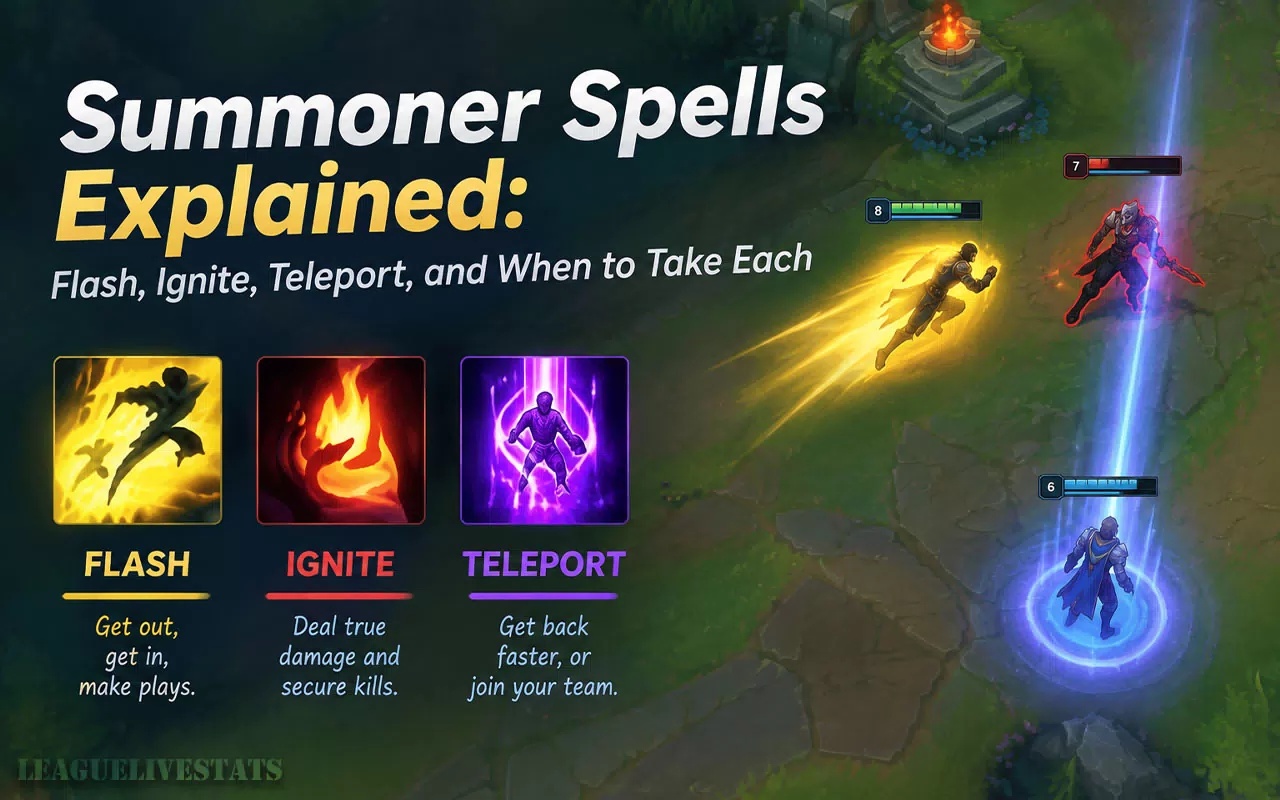
Every League of Legends match starts with a decision that gets almost no attention compared to champion select, even though it can shape the entire flow of a game: which two summoner spells to bring. New players often default to whatever the client suggests without much thought, while more experienced players treat the choice as a real strategic lever — one that changes what plays are even possible in the first place, long before the first minion wave spawns.
Flash: The Spell Almost Nobody Skips
Flash is the closest thing League of Legends has to a universal pick, and for good reason. It instantly teleports your champion a short distance in the direction you're facing or moving, which makes it useful for both escaping a bad fight and initiating one nobody saw coming. A well-timed Flash can dodge an ability that would otherwise be a guaranteed hit, close the last bit of distance needed to land a game-changing crowd control ability, or simply buy the half-second needed to survive a gank that would otherwise be fatal.
Because Flash is so flexible, roughly the only champions that skip it are the small number with a built-in mobility ability strong enough to substitute for a genuine escape — and even then, many players still take it anyway simply because losing access to it in a critical moment is rarely worth the trade-off. For almost every new player, Flash should be treated as close to a default choice rather than something to second-guess each game.
Ignite: A Kill-Pressure Tool for Aggressive Lanes
Ignite deals a burst of true damage over a few seconds and applies Grievous Wounds, a healing-reduction effect, to the target. It's most commonly taken by supports and mid laners looking to secure an early kill in lane, since the extra burst damage can turn an otherwise-survivable trade into a genuine kill, especially against champions who'd normally heal or shield their way out of a close call.
Ignite's value depends heavily on lane matchup and intent. Against a champion with strong self-healing — a lifesteal-heavy fighter, or a champion with a built-in sustain ability — the Grievous Wounds component alone can be worth taking Ignite over a purely defensive spell. Against a passive matchup where an early kill genuinely isn't realistic, Ignite's value drops considerably, since its damage and healing reduction only matter in the context of a fight that's actually happening.
Teleport: Trading Early Aggression for Map-Wide Flexibility
Teleport allows a champion to instantly travel to a nearby allied structure or ward after a brief channel, and it's most associated with top laners and, less commonly, mid laners looking for extra map presence. Its core value isn't really about any single play — it's about the flexibility it grants across an entire game: reinforcing a fight elsewhere on the map, returning to lane instantly after recalling for items instead of walking back, or responding to a bot lane dive that would otherwise be unwinnable without help.
The tradeoff is that Teleport isn't a combat spell in the way Flash or Ignite are, which means taking it alongside Flash — the standard top lane pairing — leaves no room for a second defensive or offensive tool in-lane. This is a deliberate bet that map-wide flexibility outweighs lane-specific pressure, and it's part of why Teleport tends to be more popular in slower, scaling-focused matchups than in lanes where an early kill is genuinely on the table.
Exhaust: A Defensive and Team-Fight Utility Spell
Exhaust slows the target and reduces their damage output for several seconds, making it one of the strongest defensive tools available outside of a champion's own kit. It's commonly taken by supports and, in some matchups, ADCs, since it can neutralize an enemy diver's burst potential or reduce an enemy carry's damage output during a critical team fight. Unlike Ignite, Exhaust doesn't help secure a kill directly, but it can make the difference between surviving a dive and dying to one, or between winning and losing a close team fight where reducing the enemy's damage output for a few seconds is enough to tip the balance.
Exhaust and Ignite occupy a similar mental slot for a lot of players — offense versus defense — and the right choice usually comes down to whether your role's win condition depends more on securing early kills (favoring Ignite) or surviving them (favoring Exhaust).
Heal, Barrier, and Cleanse: Situational Survival Tools
A handful of other spells round out the more defensive end of the spectrum. Heal restores health to your champion and a nearby ally, making it a common bot lane pick specifically because it can save both members of a duo lane at once rather than just the caster. Barrier grants a temporary shield, offering similar survivability without the healing component, and is often preferred in lanes with heavy burst damage where a shield timed correctly can block a full combo rather than just partially offsetting it.
Cleanse removes most forms of crowd control and grants brief tenacity, making it a specialized pick against team compositions with heavy, game-defining crowd control — a lane or team full of stuns, roots, and suppressions is exactly the situation where Cleanse's normally narrow value becomes genuinely worth the slot.
Smite: The Jungle's Mandatory Spell
Smite is functionally mandatory for anyone playing jungle, since it's the only summoner spell that deals guaranteed bonus damage to monsters, making it dramatically easier to secure jungle camps and, more importantly, contested objectives like Dragon, Rift Herald, and Baron Nashor. Outside of a jungler, Smite offers essentially no value, which is why it almost never appears in any other role's spell pairing.
Beyond simply taking it, using Smite well is its own skill — timing it correctly to secure an objective in a contested fight, rather than using it prematurely or too late, is a meaningful part of what separates a jungler who reliably wins objective fights from one who doesn't.
Building a Spell Pairing Around Your Role and Champion
Rather than memorizing a fixed list of "correct" pairings, it helps to think about summoner spells as answering two separate questions: what does my champion need to survive, and what does my role need to accomplish. A jungler always answers the survival question with Flash and the objective question with Smite, leaving no real choice to make. A support answers the survival question with Flash and then chooses between Ignite (kill pressure), Exhaust (protecting a carry), or Heal (dual-target sustain) depending on what the specific matchup and team composition call for. A top laner weighs Flash-plus-Teleport's map flexibility against Flash-plus-Ignite's lane-kill pressure based on whether the matchup is one they can realistically win early or one they're more likely to need to scale through safely.
Thinking about spell selection this way — survival tool plus role-specific tool — tends to produce better decisions than defaulting to whatever's popular in a given patch, since the "best" pairing genuinely does shift based on matchup, team composition, and your own win condition in a specific game.
The Bottom Line
Summoner spells rarely get the same attention as champion picks or item builds, but the right pairing meaningfully shapes what your champion is actually capable of doing over the course of a match. Flash is close to a universal pick for the flexibility it offers in both offense and defense, while Ignite, Teleport, Exhaust, Heal, Barrier, and Cleanse each answer a more specific need depending on your role, matchup, and what your team's win condition actually looks like. Smite remains the one mandatory exception, existing purely for junglers and central to how objectives get contested throughout a game. Treating this choice as a real decision, rather than an afterthought before champion select even finishes loading, is a small habit that pays off in a surprising number of close games.
For the current full list of summoner spells and any recent balance adjustments, Riot Games' official summoner spells page and the League of Legends Wiki are both reliable references to check as the meta shifts.