Champion select is usually treated as five separate decisions: each player picks something they're comfortable on, maybe checks the matchup in their lane, and hopes the rest works itself out. Stronger teams treat it differently, as a single decision about what kind of game the team is trying to play, with each pick either supporting that plan or quietly undermining it. Understanding the main team composition archetypes makes it much easier to see why some drafts feel coordinated and others feel like five players playing five different games.
Engage Compositions: Winning the Fight by Starting It Well
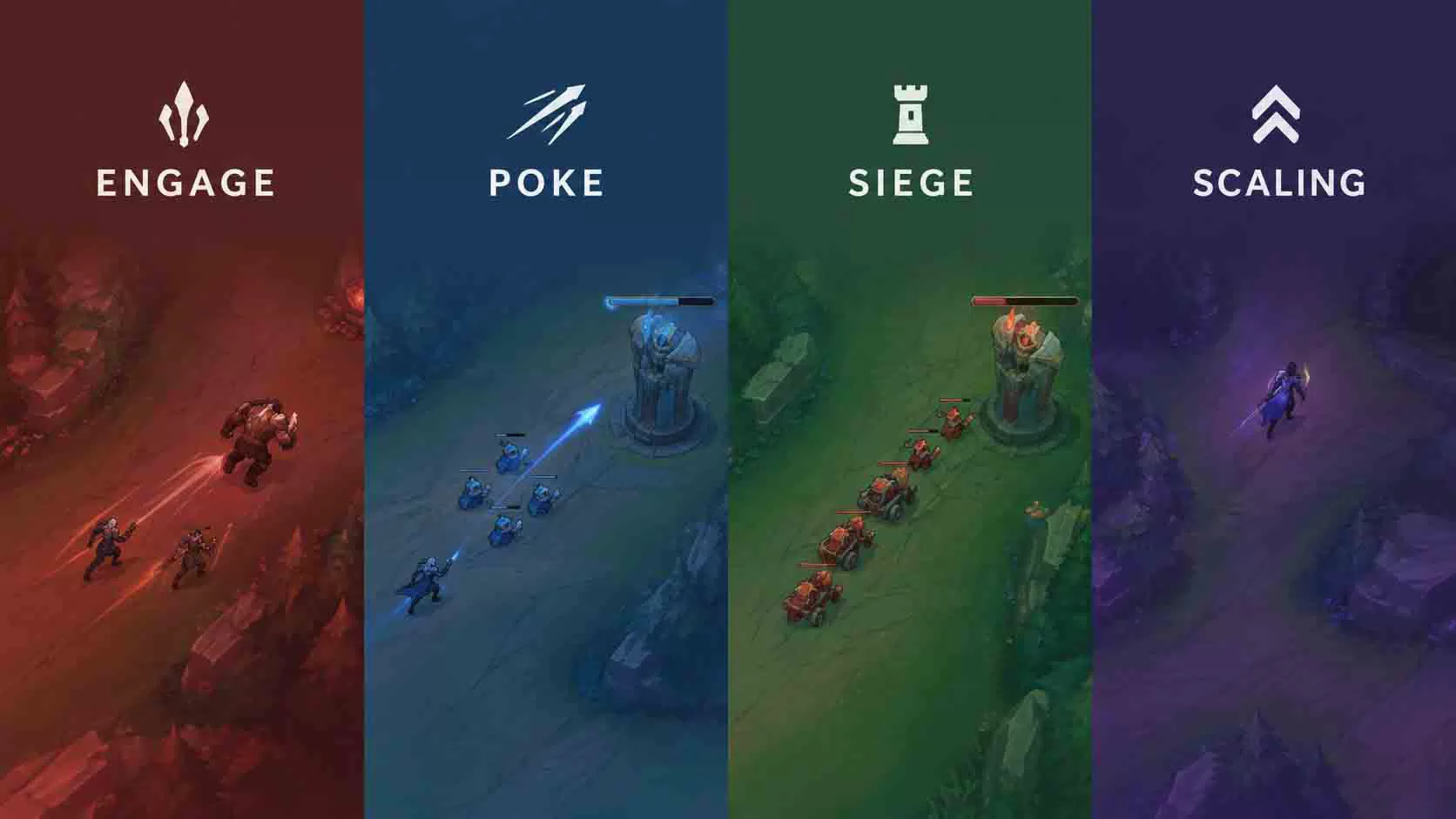
Engage compositions are built around one idea: starting a team fight on the team's own terms, with crowd control and burst landing before the enemy can react. These comps lean heavily on champions with reliable initiation tools, usually a mix of tanks and crowd control-heavy supports or junglers, backed by damage dealers who can follow up on a locked-down target immediately.
The strength of an engage comp is that it forces fights to happen on a favorable timeline, which is especially powerful around objectives where the enemy has to be standing in a specific spot. The weakness is that engage comps tend to rely on a small number of key initiation tools, so if the enemy can dodge, cleanse, or kill the engage champion before the fight begins, the entire plan collapses and the remaining team members are left without a clear way to start a fight on their own.
Poke Compositions: Winning Before the Fight Even Happens
Poke compositions lean on long-range abilities that deal damage from a distance, wearing down the enemy team's health bit by bit before any real engagement happens. The goal isn't to win a straight team fight so much as to make the enemy team low enough on health that they can't fight at all, which then lets the poke team secure objectives or push towers freely while the enemy recovers.
Poke comps are strong in the early and middle parts of a game, when enemy sustain is limited and long-range damage accumulates unchecked. They struggle against strong engage tools, since a poke team that gets forced into close-range fighting loses most of its advantage, and against heavy sustain or healing, which can reset the damage the poke team spent minutes accumulating.
Siege Compositions: Taking Towers Without Needing Fights
Siege compositions focus on destroying towers and structures from outside the enemy's reach, using champions with extremely long range or strong wave-clear to push lanes down faster than the enemy can respond. These comps often combine poke with very strong tower-taking potential, forcing the enemy to either leave their defensive position and fight on bad terms or watch their base get dismantled piece by piece.
Siege is very effective against teams that don't have a reliable way to start fights or punish a team that's playing at a distance. It struggles against compositions with strong flank or dive potential, since siege champions are typically fragile and positioned far from their own frontline, making them vulnerable to anyone who can reach them quickly.
Scaling Compositions: Surviving Early to Dominate Late
Scaling compositions are built around champions that are weak early but become far stronger as items and levels accumulate. The entire plan is to survive the early game with minimal damage and then take over once the team's carries reach their strongest forms, at which point the enemy team ideally can't match them in a straight fight regardless of how far ahead they were earlier.
The risk with scaling compositions is the cost of falling too far behind early, since a team that spends the first twenty minutes getting picked apart often never gets the chance to reach its late game. Playing a scaling comp well means prioritizing farm and safety over aggressive plays, and avoiding fights that don't have to happen until the team's power spike arrives.
Why Mixing Archetypes Badly Causes Problems
The most common drafting mistake isn't picking an objectively weak champion, it's picking champions that are strong individually but built around incompatible plans. A poke champion paired with a team that wants to engage constantly forces the team to choose between waiting for poke damage to accumulate and starting fights immediately, and that kind of mixed message usually results in neither plan being executed well.
This doesn't mean every team needs to be a pure version of one archetype — most strong comps blend elements, such as an engage-focused team with one or two poke options to chip at the enemy before fights begin. The key is that there's still a clear primary identity, with the other elements supporting that plan rather than competing with it.
Playing Against Each Archetype
Understanding the archetypes is just as useful for reading the enemy team as for building your own. Against engage comps, positioning and vision matter most, since avoiding the initial engage often decides the fight outright. Against poke comps, the answer is usually either forcing a fight quickly before the poke damage accumulates or building sustain to outlast it. Against siege comps, the plan is to contest the push early rather than let it build momentum, and against scaling comps, the plan is to apply early pressure and close out the game before they reach their strongest stage.
The Bottom Line
Team compositions aren't just a collection of five champions, they're a shared plan for how the game should be played, and understanding the main archetypes makes it easier to recognize what that plan is — both for your own team and for the enemy's. Knowing which archetype you're playing, what its weaknesses are, and how to avoid or exploit them is one of the clearest ways to turn individual skill into actual team wins.
For more on champion classes and team strategy, Riot Games' official champion guide and the League of Legends Wiki's champion classes page are both useful references to check.