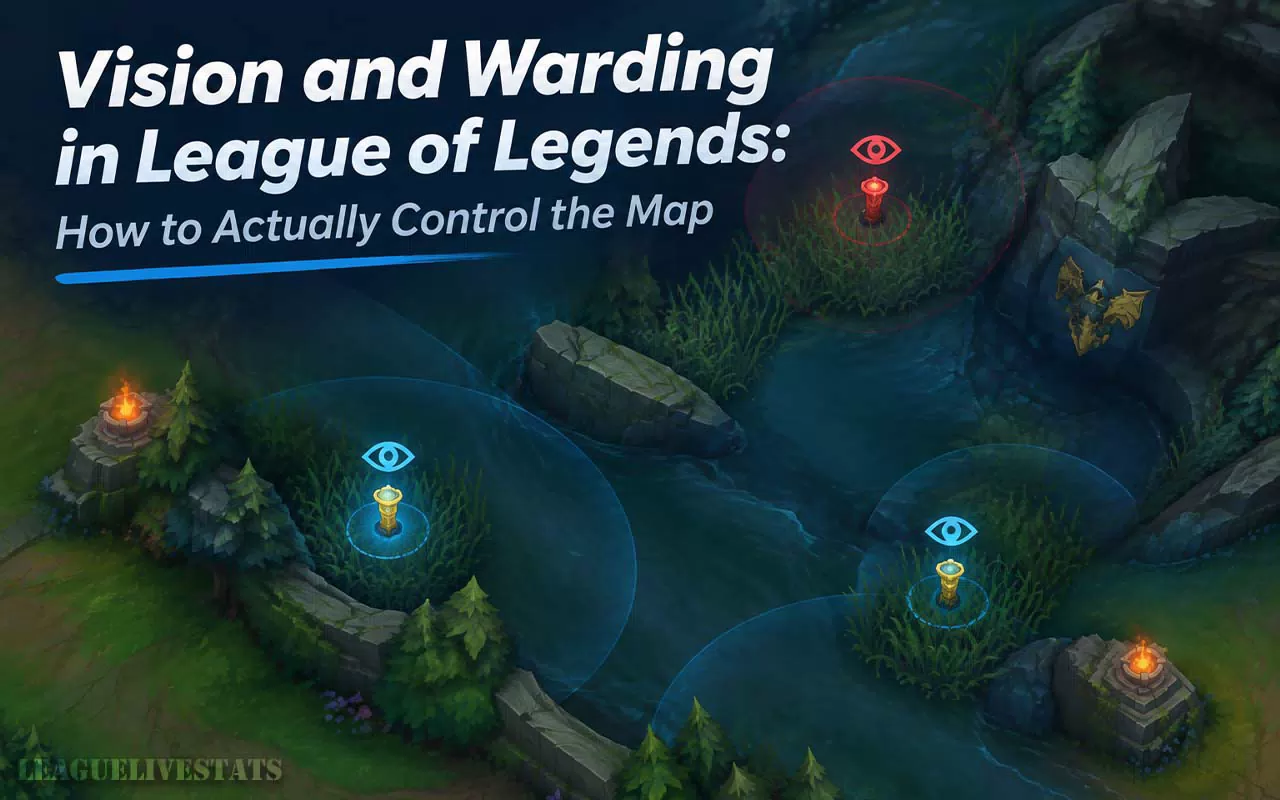
Most players understand that wards are good and that dying to an ambush from the bush is bad, but very few treat vision as the resource it actually is. Gold and experience get tracked obsessively in every post-game screen, yet vision score barely gets a glance, even though it quietly decides who gets picked off in the river, who can safely take an objective, and who walks into a fight already knowing where the enemy team is standing.
Vision Isn't About Wards, It's About Information
The trinket and the Control Ward in the shop are just tools. What they're buying is information, and information changes decisions. A support who wards the enemy jungle entrance isn't doing it to "get vision score," they're doing it so their team knows a gank is coming thirty seconds before it happens, which turns a potential kill for the enemy into a dodged skill shot and a free counter-engage instead. The actual value of a ward is measured in the decisions it changes, not in the small stat line at the end of the game.
This is why a ward placed in a spot nobody ever walks through is close to worthless, even though it technically counts toward vision score. Good warding is about predicting where the enemy team needs to go — a jungler pathing toward a lane, a flank route into a fight, a bush a marksman needs to walk through to reach a dragon — and putting a ward exactly there before it matters.
Defensive Wards vs. Aggressive Wards
There's a meaningful difference between warding to survive and warding to create pressure. Defensive wards go in spots your own team is vulnerable — a river bush near your lane, a jungle entrance close to your tower, a flank route into your own base during late game. These wards exist purely to prevent disasters, and they matter most when your team is behind or when a single bad engage could end the game.
Aggressive wards go deep into contested or enemy territory — inside the enemy jungle, near enemy buff camps, or in bushes along a path the enemy support has to take to ward their own side. These are riskier to place and often die quickly, but they buy the kind of information that lets a team make a play rather than just avoid one. Knowing when to shift from defensive to aggressive warding, usually once a team has priority or a gold lead, is a bigger skill jump than most players expect.
Control Wards Matter More Than People Think
A Control Ward doesn't just grant vision, it actively denies the enemy's vision in that spot, and it can't be seen or removed unless the enemy has vision of the ward itself or a way to see invisible wards. Placing one in a dragon or Baron pit before a contested objective spawn is one of the single highest-value actions available in the mid-to-late game, since it can single-handedly prevent an enemy team from safely setting up an ambush around that objective.
Buying a Control Ward every single back, treating it as a mandatory purchase rather than an optional one, is one of the simplest habits that separates players who understand vision from players who don't. The gold cost is trivial compared to the value of denying a single enemy pick or preventing a contested objective from going uncontested.
Clearing Vision Is Just as Important as Placing It
Sweeping enemy wards away is frequently ignored, but a team that only places wards without ever clearing the enemy's is playing half the game. If the enemy has vision on your jungle, they know exactly when it's safe to invade or set up around an objective, and no amount of warding on your own side compensates for that. Carrying a Sweeper Lens or using a jungler's built-in true sight ability to clear key bushes before a fight or an objective attempt is often the difference between contesting an objective safely and walking into a four-man ambush.
Reading Vision, Not Just Placing It
Beyond placing and clearing wards, simply paying attention to the minimap constantly is a separate skill that matters enormously. A missing enemy jungler on the minimap for more than a few seconds is itself a piece of information — it usually means a gank is coming somewhere, and adjusting positioning conservatively the moment that happens prevents a huge number of deaths that have nothing to do with mechanical skill and everything to do with awareness.
The Bottom Line
Vision control rewards patience and habit far more than mechanical skill. Warding predictively rather than randomly, buying Control Wards as a default rather than a luxury, actively clearing enemy vision rather than only adding your own, and simply glancing at the minimap on a consistent rhythm will improve win rate more reliably than almost any single mechanical improvement at most skill levels. It's not a flashy part of the game, which is exactly why so few players take it seriously — and exactly why the ones who do tend to win more of their close games.
For current ward and trinket details, Riot Games' official item page and the League of Legends Wiki's vision page are both solid references to check.