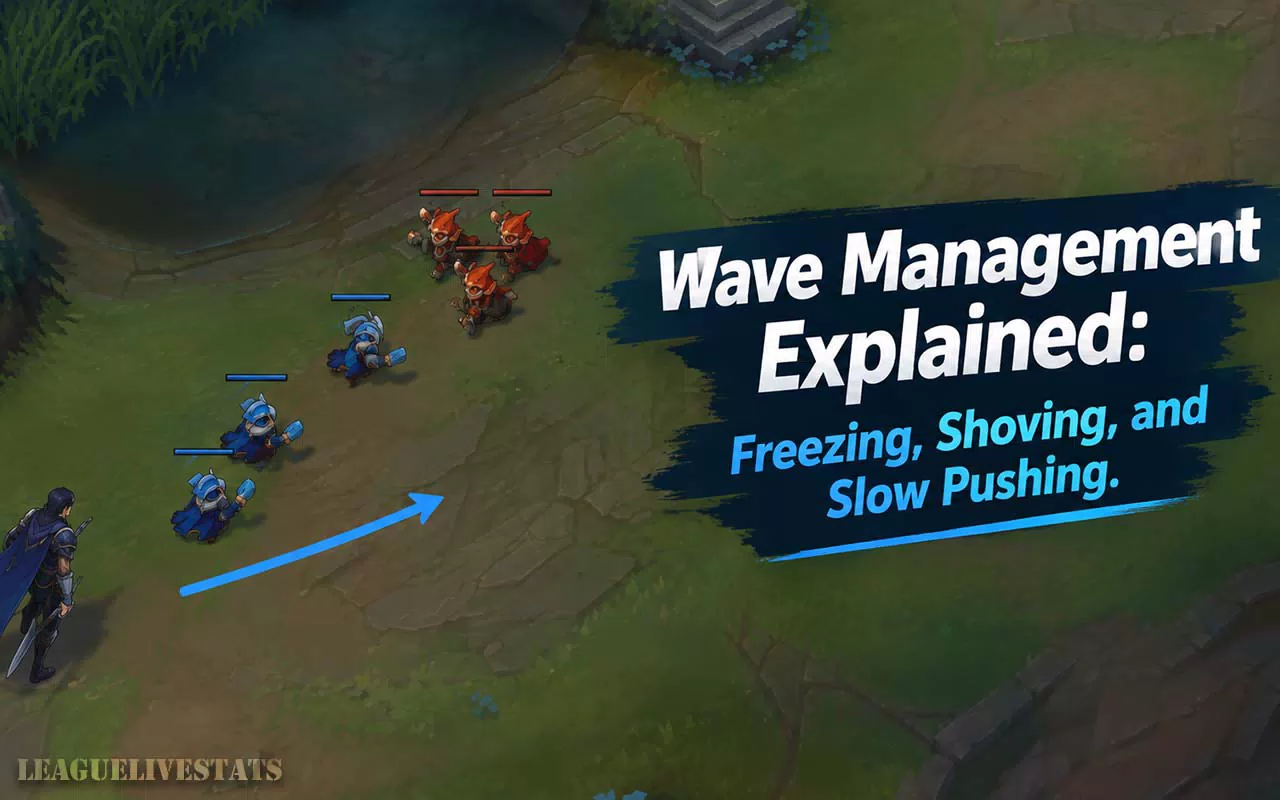
Most new players think of laning phase almost entirely in terms of trades and kills, and treat the minion wave itself as background noise that just happens to be there while the real fight is going on between champions. Experienced players see it the opposite way around — the wave is often the actual battlefield, and controlling where it sits on the map decides who's even allowed to trade safely in the first place.
Why the Wave Matters More Than It Looks Like It Should
A minion wave isn't neutral. Wherever it's sitting determines who has to walk further to reach the other player, who's standing closer to their own turret for safety, and who's exposed to a jungle gank without an easy escape route. A player standing next to a wave that's pushed deep into the enemy's side of the lane is walking distance away from their own tower and often several seconds away from any help, while a player who's pushed the wave to their own tower is basically playing from a position that's almost impossible to punish. None of this shows up as a stat anywhere, which is exactly why it gets underrated so consistently.
Pushing: The Simplest State, But Not Always the Right One
Pushing simply means killing minions faster than they're being killed on the other side, which causes the wave to move toward the enemy tower over time. Pushing is useful when the goal is to reach the enemy tower quickly to threaten it, to clear a wave fast in order to roam or recall, or to force the enemy laner to choose between losing farm or tanking tower shots to keep up. The tradeoff is that a pushed wave leaves the pushing player deep in enemy territory, exposed to ganks with a long walk back to safety if things go wrong.
Freezing: Trading Safety for a Long-Term Trap
A freeze happens when the wave is deliberately kept in roughly the same spot for an extended period, usually just outside the pushing player's tower range, by matching the enemy's last-hits exactly rather than trying to push through the wave. A frozen wave near your own tower is one of the strongest defensive tools in the entire laning phase, because the enemy laner has to walk far past their own safety net to farm at all, which makes them enormously vulnerable to a gank the moment the jungler shows up.
Freezing is a deliberate skill and not something that happens by accident — it requires last-hitting only the minions closest to dying without ever attacking the wave itself, since attacking the wave directly will push it rather than hold it in place. It's most valuable when a player is already ahead and wants to punish the enemy for trying to catch up on farm, or when a jungler has communicated a gank is coming and the lane wants to set up the enemy for it.
Slow Pushing: Building Toward a Big Wave on Purpose
A slow push happens when a wave is allowed to grow slightly larger over a few cycles by only killing minions with abilities or a bit of extra damage, rather than clearing the wave fully with basic attacks each time. This builds toward a much larger wave than normal, which eventually becomes big enough to force a difficult choice: let a huge wave crash into your own tower and lose a large chunk of farm and tower health, or walk up to deal with it and become an easy gank target in the process.
Slow pushing is one of the most common setups behind a coordinated roam or gank, since it deliberately creates a moment where the enemy laner is forced into a bad position regardless of what they choose to do. Recognizing when an enemy is slow pushing rather than farming normally, and reacting to it early rather than waiting for the wave to become unmanageable, is a skill that takes real repetition to build.
Matching Wave State to the Actual Situation
None of these three states is universally correct — the right choice depends entirely on what's happening around the lane at that moment. Being ahead in a lane generally rewards freezing near your own tower to farm safely while denying the enemy, being significantly behind generally rewards pushing to reset at tower and minimize further losses, and wanting to set up a play with the jungler generally rewards a slow push timed around when the gank is expected to land.
The biggest single mistake at lower skill levels isn't picking the wrong wave state on purpose, it's not thinking about wave state at all and just farming reactively without any plan for where the wave should end up. Even picking one wave state and sticking to it deliberately, rather than farming on autopilot, tends to produce noticeably better lane outcomes almost immediately.
The Bottom Line
Wave management is one of the least visually exciting parts of League of Legends, which is probably why it gets skipped over by so many guides in favor of flashier mechanical advice. But the wave decides positioning, gank vulnerability, and tower pressure for both players in a lane at every single moment, which makes it one of the highest-leverage things to actually think about consciously. Learning to recognize a freeze, a push, and a slow push — both your own and the enemy's — and understanding why each one is being used, tends to translate into cleaner, safer laning phases almost immediately.
For more detail on minion mechanics and aggro rules, the League of Legends Wiki's minion page is a useful reference to check.